Get paid faster: online payments, reminders and clear terms
Practical ways to shorten the wait between sending an invoice and getting paid, from clear terms and deposits to online payments and polite reminders.
Finishing the work is only half the job. The other half is the wait between sending an invoice and seeing the money arrive, and for many small businesses that wait is where cash flow gets tight.
You cannot control a client's payment run, but you can remove nearly every reason for delay. This guide covers the three levers that matter most: clear terms, easy online payment, and reminders that go out without you having to chase.
Why invoices get paid late
Late payment is rarely about a client refusing to pay. It is usually friction:
- The invoice went to someone who does not process payments.
- The due date was unclear, so it was not prioritized.
- Paying meant finding bank details, logging into a banking app and typing a reference.
- Nobody followed up, so it slipped to the next payment run.
- A question about one line item held up the whole invoice.
Every fix below targets one of these.
Set clear terms before the work starts
The best time to agree on payment is before you begin, when everyone is enthusiastic about the project.
- Agree payment terms in the quote or contract. "Due on receipt", "Net 15" or "Net 30" are common. Choose what fits your work and your cash flow.
- Ask who processes invoices, and get their email address.
- Ask whether the client needs a purchase order number on invoices.
- Take a deposit on larger jobs. Invoicing part of the fee upfront is common, and it protects you if the project stalls.
- Invoice by milestone on long projects, rather than one large bill at the end.
Then repeat the terms on every invoice, with an actual date: "Due within 15 days, by October 20, 2026."
If you want a refresher on what else belongs on the invoice itself, see how to create a professional invoice.
Make paying take one click
Think about it from the client's side. If your invoice has a "Pay now" button that accepts a card or a bank payment, they can pay the moment they approve it. If it only lists bank details, paying becomes a task for later.
Offer more than one way to pay
Different clients prefer different methods. Card payments are quick for small invoices. Bank transfers and direct debits often suit larger or recurring ones. Offering a sensible choice removes an excuse to wait.
Understand the fees
Payment providers charge processing fees, and they vary by provider, country and payment method. Some businesses absorb the fee as a cost of getting paid sooner. Others prefer bank transfer for large invoices to keep fees down. Whatever you choose, record the fees properly so your books show what you actually received.
How it works in BooksBat
In BooksBat you connect your own payment account, and customers pay right from the invoice. The supported providers are Stripe, PayPal, Square, Razorpay, Mollie, GoCardless and Lemon Squeezy. A few things worth knowing:
- The money goes to your own account with that provider.
- BooksBat adds no fee by default. You pay only your provider's own processing fees.
- Fees post to your books automatically, so your books show both the payment and the fee without extra data entry.
- Plan availability: the Free plan supports Stripe. Pro and Business support all seven providers. See pricing.
| Situation | A good option to offer |
|---|---|
| Small one off invoices | Card payment |
| Large project invoices | Bank transfer, plus card for convenience |
| Retainers and repeat billing | Direct debit, alongside a recurring invoice |
| International clients | A provider that supports their country and currency |
Reminders that do the chasing for you
Most people hate chasing money, so they put it off, and the invoice gets older. Automatic reminders take the awkwardness out because they are routine, not personal.
A simple reminder schedule
A sequence that works for many businesses:
- A few days before the due date: a friendly heads up that the invoice is due soon, with the payment link.
- On the due date: a short note that payment is due today.
- A week after: a polite reminder that the invoice is now overdue.
- Two weeks after: a firmer message, and a personal email or call from you.
Keep each message short, include the invoice number, amount and due date, and always include the link to pay.
Use the invoice status
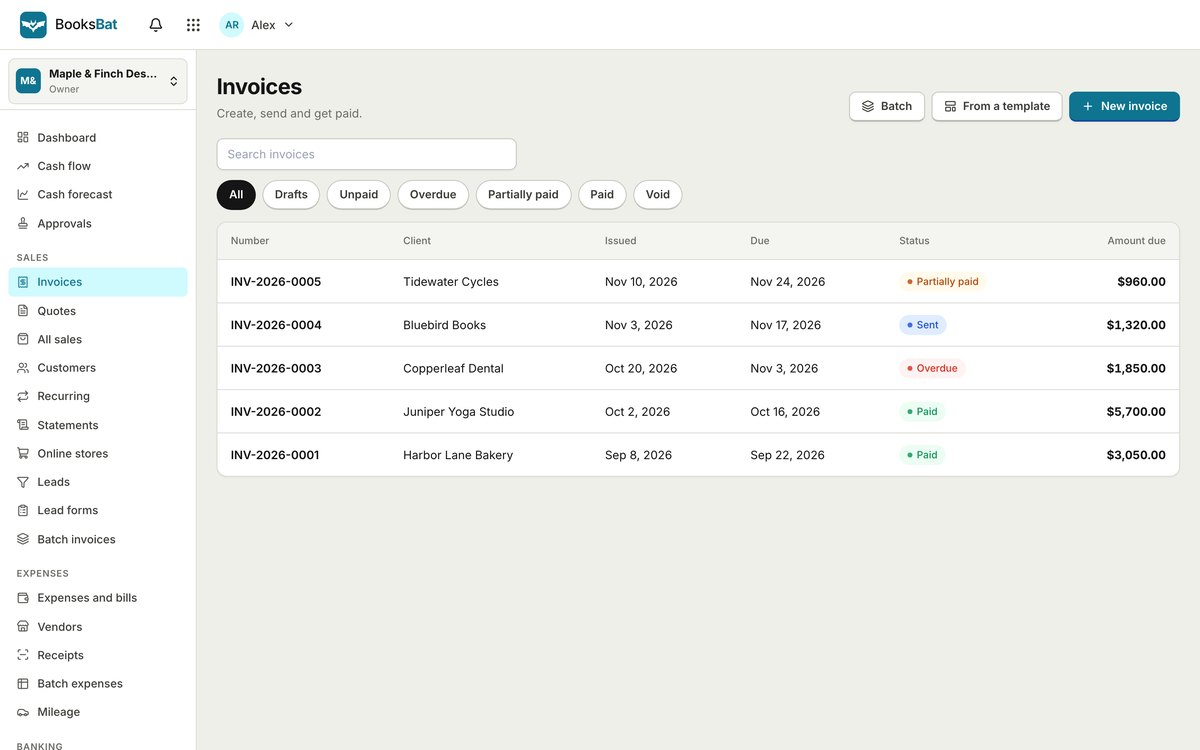
In BooksBat, invoices move through statuses: draft, sent, viewed, partially paid, paid, overdue and void. The "viewed" status is especially useful. If an invoice has been viewed but not paid, your follow up can be specific: "I can see the invoice came through. Is there anything holding it up?" If it has not been viewed, it probably went to the wrong person.
Automatic reminders are built in, so once they are switched on, overdue invoices get followed up without you remembering.
Cut the back and forth
Every question on an invoice is a delay. A few habits reduce them:
- Start from an accepted quote. BooksBat quotes can be accepted online by the customer. Build the invoice from the same line items, so it matches exactly what they agreed to.
- Write clear line items that say what was done, with quantities and rates.
- Send statements to clients with several open invoices, so they can see everything they owe in one place.
- Use recurring invoices for retainers, from weekly to yearly, so they go out on time every time.
- Record partial payments properly, so the remaining balance is clear to both of you.
If you want to see how all of these connect across a whole job, from first quote to payment in the bank, read small business paperwork from quote to payment.
When a payment is really late
Sometimes a client simply does not pay. Stay calm and stay professional:
- Call or email the person you worked with directly, not only the accounts address.
- Confirm they received the invoice and ask if there is a problem with it.
- Offer a payment plan if they are struggling. Part payment now is better than none.
- Pause further work until the account is up to date, if your contract allows.
- If it still goes nowhere, look at the formal options in your country, such as a letter before action or a small claims process. Rules vary, so get local advice.
The short version
Getting paid faster is mostly about removing friction. Agree terms before you start, invoice promptly and clearly, put a payment link on every invoice, and let reminders follow up for you. Check which invoices have been viewed so your follow ups are specific, not awkward.
You can create a free account, connect your Stripe account and send your next invoice with a pay now link through BooksBat.